


If you run a business or are self-employed, you have probably been hearing about Verifactufor months, and the date keeps changing. The latest twist came on 5 October 2026: the Spanish Tax Agency announced it wants to postpone it again, until October 2028, to coincide with mandatory e-invoicing. We explain where the timeline stands, what is official and what is not, and what you should already check on your business computers and software to avoid surprises.
What Verifactu is, in two minutes
Verifactu is the system the Spanish Tax Agency uses to make sure that invoices issued by businesses and the self-employed cannot be deleted, modified or hidden after they are created. It comes from the 2021 Anti-Fraud Law and the Invoicing Systems Regulation (Royal Decree 1007/2023).
In practice, it does not make you invoice differently, but requires that the software you invoice with meets certain requirements:
- Each invoice generates a record that cannot be altered, chained to the previous one.
- Invoices carry a QR code so the customer can check them with the Tax Agency.
- The software keeps a history of any change or cancellation.
- The software maker must sign a statement of compliance declaring that its program meets the regulation.
There are two ways to comply: the Verifactu mode, in which the software sends each record to the Tax Agency instantly, and the "non-Verifactu" mode, in which records are stored signed on your system and handed over if the Tax Agency asks for them. The first is easier to maintain, but needs a reliable internet connection at the time of invoicing.
The Verifactu timeline: what is official and what is not
This is where the confusion lies. Verifactu has already been postponed several times, and right now two timelines coexist: the one published in the BOE (Spain's Official Gazette) and the one the Tax Agency has announced.
What is in force today (published in the BOE)
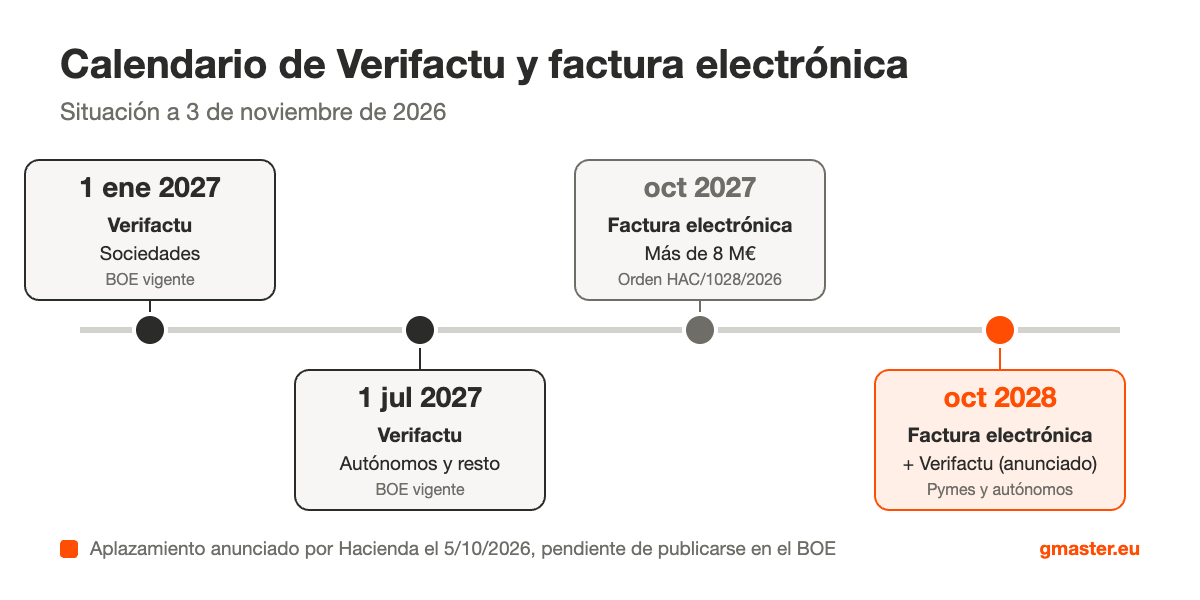
- 1 January 2027: companies and entities that pay Corporation Tax.
- 1 July 2027: self-employed workers and other businesses that use software to invoice.
These dates were set by Royal Decree-Law 15/2025, which pushed the original 2026 dates back by a year.
What the Tax Agency has announced (pending approval)
On 5 October 2026, the Ministry of Finance announced its intention to move Verifactu to October 2028 for the self-employed and SMEs with a turnover of up to €8 million. The aim is for it to coincide with mandatory e-invoicing for those same businesses.
Important: until that change is published in the BOE, the legally valid dates are still those of 2027. The sensible approach is to plan with 2028 in mind, while continuing to prepare.
And mandatory e-invoicing is also on its way
They should not be confused: Verifactu controls how your invoices are generated and stored; the electronic invoice (from the Crea y Crece Law) requires invoices between businesses and the self-employed to be sent in a structured electronic format, not as a PDF, and to report when they are paid.
Its timeline has been official since Order HAC/1028/2026 came into force on 6 October 2026:
- October 2027: businesses and professionals with a turnover of more than €8 million a year.
- October 2028: all other businesses and the self-employed.
The good news is that, if the postponement is confirmed, most SMEs and self-employed workers on the Costa del Sol will be able to adapt to both at once, with a single, well-planned software change.
Does Verifactu affect me?
It affects almost all businesses and self-employed workers who issue invoices with software: an invoicing program, an ERP, the POS in a shop or restaurant, or an online shop that generates invoices automatically.
Mainly excluded are businesses already in the SII (Immediate Supply of VAT Information) and some specific cases. If you have doubts about your tax situation, your accountant should confirm it. What we can help you with is the technical side: which software you use, whether it is ready and what needs to change.
7 things to check now in your business
Even if the date is delayed, the change is inevitable. These are the checks we carry out with our clients so there are no surprises when it becomes mandatory:
- Take stock of where you invoice from. The office software, the shop's POS, the online shop, an Excel template… Many businesses invoice from more places than they think.
- Ask your software provider. Ask them to confirm in writing whether their program already complies with Verifactu or when it will, and whether the update has a cost.
- Check your online shop. If you sell with WooCommerce or PrestaShop and the shop issues invoices, the invoicing plugin must also be adapted.
- Check the computers used for invoicing. Up-to-date software needs an up-to-date computer. Computers with unsupported systems, such as Windows 10 without extended updates, are a risk.
- Secure your internet connection. In Verifactu mode, each invoice is sent to the Tax Agency instantly. A stable network and Wi-Fi are no longer a luxury.
- Keep your digital certificate up to date. It is needed for many procedures with the Tax Agency. Check that it is installed on the computers that need it and when it expires.
- Protect your invoicing data. Verifactu records must be kept. Good backups and basic cybersecurity prevent you from losing them through a fault or an attack.
What happens if I do not adapt?
Once the obligation comes into force, using invoicing software that does not comply can lead to a fine of up to €50,000 per financial year. For makers and sellers of non-compliant software, the fine can reach €150,000. The Tax Agency has also warned that it will cross-check Verifactu data with e-invoicing data, so inconsistencies will be easy to detect.
Our advice: use the extra time, do not waste it
Every postponement has led many businesses to put it off. The problem is that when the final date arrives, thousands of businesses will want to change software at the same time, and providers and technicians will be overloaded. Doing it calmly lets you choose the right software, test it, train your team and renew whatever is needed.
If you also coordinate the change with your accountant, as we do with several advisory firms and agencies that trust us, everything fits: they handle the tax side and we make sure the computers, the software and the backups work.
Frequently asked questions about Verifactu
When is Verifactu mandatory?
According to the BOE, on 1 January 2027 for companies and on 1 July 2027 for the self-employed and everyone else. The Tax Agency has announced that it will delay it to October 2028 for SMEs and self-employed workers with a turnover of up to €8 million, but the regulation still has to be approved.
Do I have to change my invoicing software?
Not necessarily. Many programs will adapt with an update. What matters is that your provider confirms that its software complies with the Regulation and gives you the statement of compliance.
Are Verifactu and e-invoicing the same thing?
No. Verifactu ensures your invoices cannot be tampered with; e-invoicing requires invoices between businesses to be sent in electronic format. They are two different obligations, although ideally one program handles both.
Does it affect me if I have an online shop?
If your shop issues invoices, yes. The plugin or system that generates them must comply with Verifactu. If we built your website, we will review with you what needs updating.
We help you prepare your business for Verifactu
At Master Informática we have been providing IT maintenance for businesses in Benalmádena, Marbella and the Costa del Sol for more than 20 years. We review where and how you invoice, talk to your software provider, bring your computers up to date and leave your backups working. If you have an online shop, we also check that its invoicing is ready.
📞 629 555 302 · 💬 WhatsApp · ✉️ Contact form
Information updated on 3 November 2026. Dates may change if the new postponement is published in the BOE; we will update this article when that happens.
IT maintenance